

PEO vs. ASO: What's the Difference and Which Is Right for Your Company?
Short answer: A PEO becomes your co-employer and puts your employees on its benefits plans and tax accounts. An ASO handles the same administrative work (payroll processing, HR administration, compliance support) while you stay the sole employer and keep your own benefits plans. A PEO usually wins on benefits pricing for small companies. An ASO gives you more control and is often a better fit as you grow.
After nine years inside a publicly traded PEO, this is the comparison I walk business owners through most often.
What is a PEO?
A PEO (professional employer organization) enters a co-employment relationship with your company. Your employees are reported under the PEO's tax accounts, and they get access to the PEO's large-group benefits plans. You still run your business and manage your people day to day.
What is an ASO?
An ASO (administrative services organization) provides HR administration as a vendor. It runs payroll and handles HR admin and compliance support, but there's no co-employment. Your company stays the employer of record, files under its own tax accounts and buys its own benefits.
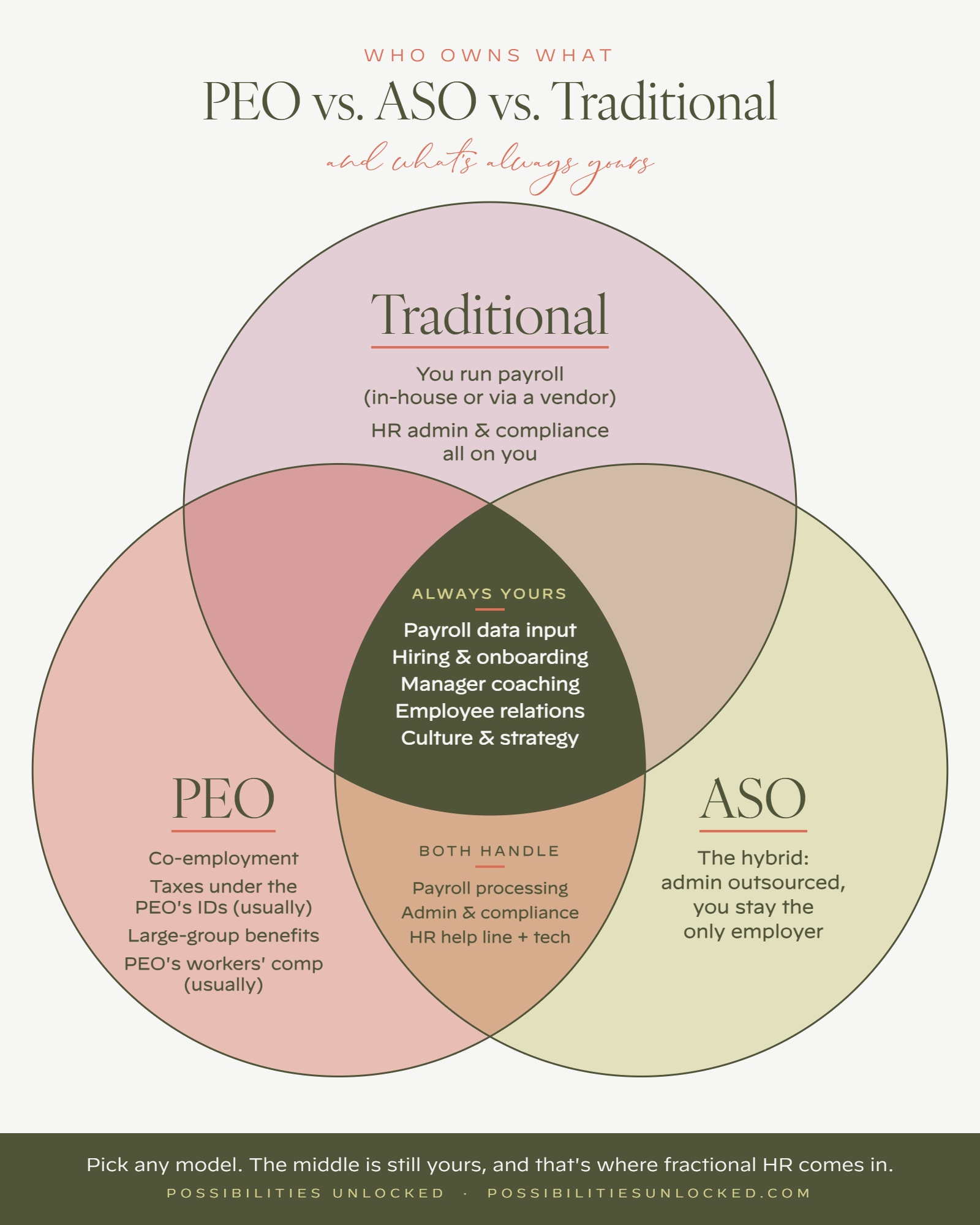
PEO vs. ASO at a glance
Employer of record: PEO: shared through co-employment. ASO: you alone.
Benefits: PEO: its large-group plans. ASO: plans you choose and buy.
Payroll taxes: PEO: filed under the PEO's tax IDs. ASO: filed under yours.
Control: PEO: standardized policies and plans. ASO: you set your own.
Typical fit: PEO: smaller companies that want benefits buying power. ASO: companies that want control or have outgrown a PEO.
Leaving: PEO: you rebuild benefits and tax accounts. ASO: usually simpler.
When a PEO makes more sense
You have fewer than about 50 employees and want better benefits than you can buy on your own
You want one vendor to process payroll and handle benefits, workers' comp and compliance administration
Recruiting is competitive and benefits are part of how you win candidates
When an ASO makes more sense
You can buy competitive benefits on your own, often as you pass 50 to 100 employees
You want full control of your plans, policies and employer identity
Co-employment creates friction with investors, lenders or acquirers
Your PEO costs keep rising faster than the value you use
What neither one gives you
A PEO and an ASO both handle administration. Both process payroll, but neither owns what goes into it: new hires, pay changes, hours and terminations still come from your side. Neither one coaches your managers, runs your investigations, builds your culture or plans the people side of your growth. That work still needs someone inside your business. For many companies with 10 to 75 employees, that's a fractional HR leader.
Frequently asked questions
Is an ASO cheaper than a PEO?
The admin fee is often lower, but total cost depends on benefits. If a PEO's group plans save you more on premiums than its fees cost, the PEO can be cheaper overall. Compare total cost, not the admin fee alone.
Can I switch from a PEO to an ASO?
Yes. You'll set up your own benefits plans and tax accounts, so plan for 60 to 90 days and time it to January 1 or your benefits renewal. See How to Switch PEOs Without Disrupting Payroll or Benefits; most of the same steps apply.
Does an ASO provide an HR manager?
Usually not one inside your business. Most ASOs offer an HR support line and compliance resources, similar to a PEO.
See what your current setup is missing
If you're on a PEO today, take the free PEO Gap Check. It takes two minutes and shows the top three gaps your PEO isn't covering.
UNTIL NEXT TIME,
Stacey
Stacey Dennis, SHRM-SCP, is the founder of Possibilities Unlocked, a fractional HR firm for growing companies. She spent nine years inside a publicly traded PEO before starting her firm.